Insurance and Safety for Clearance London
 At Clearance London we place safety and insurance at the centre of every clearance, removal and waste management task. This page explains how our approach to public liability insurance, staff training, the provision of personal protective equipment and our risk assessment process protect clients, members of the public and our teams. Whether you are arranging a domestic clearance, a commercial clearance in London, or specialist clearance services across the capital, our systems are designed to reduce risk and provide clear, documented reassurance.
Public Liability Insurance for London Clearance Services
Every operation is backed by robust public liability insurance that covers accidental damage and injury occurring during a clearance. Our public liability cover is arranged to meet the needs of clearance in London where dense urban environments and high footfall increase potential exposure. We maintain up-to-date certificates of insurance and can provide evidence of cover when required by landlords, local authorities or site managers. The policy limits are selected to reflect the scale of operations, and our claims procedures ensure incidents are logged and managed swiftly to protect everyone involved.
 Our public liability approach for London clearances includes pre-job checks, contractor vetting and an incident reporting protocol. We do not rely on verbal assurances—every site visit includes documented verification that the necessary insurance is active and sufficient for the task. This reduces project delays and ensures that all parties understand responsibilities before work begins, whether the job is a single-item removal or a full property clearance.
Staff competence is a cornerstone of safety for Clearance London and our affiliated teams. All staff undergo a structured induction, with refresher training scheduled regularly. Training covers manual handling techniques, safe use of trolleys and lifting equipment, traffic management around vans at kerbsides and safe working at height when required. We emphasise practical demonstration and competency checks: theoretical learning is combined with on-site mentoring until operatives demonstrate safe performance to our supervisors.
Ongoing Training and Supervision
 Our training regime is tailored for removals, rubbish clearance, and clearance of commercial premises across London. Topics include hazardous materials awareness, sharps and asbestos identification (where appropriate advice is given to stop, cordon and report), and basic first aid. Supervisors complete additional leadership and incident management modules so that they can lead safe clearances and respond competently to changing site conditions. Continuous improvement is built into our programme by reviewing near-misses and small incidents to update procedures.
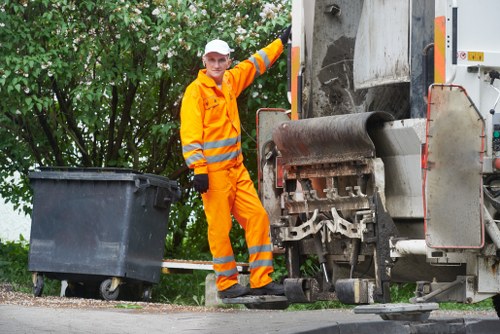
PPE is standard issue for all team members on site. Our minimum requirement for London clearance operations includes protective gloves, steel-toe boots, high-visibility clothing and eye protection where debris may be present. For tasks with specific hazards we add respiratory protection, safety helmets and cut-resistant sleeves. A typical PPE checklist we enforce is:
- Gloves — puncture and cut resistant;
- Footwear — steel or composite toe, slip-resistant soles;
- High-visibility garments — to comply with urban traffic and site safety;
- Eye and face protection — when breaking down fixtures or handling dust;
- Respiratory protection — when dust or airborne particles present a risk.
Risk assessment is central to how we operate across the city. Before any job is scheduled, our team completes a written site risk assessment tailored to the property and nature of the clearance. This assessment identifies hazards, evaluates the likelihood and severity of harm, and defines control measures. As a company offering specialist clearance and general clearance services in London, we account for variables like staircase access, narrow alleyways, parking restrictions and building occupancy.
 The risk assessment process follows a clear sequence: site reconnaissance, hazard identification, risk evaluation, implementation of controls, assignment of responsibilities and documentation. Controls range from simple adjustments such as cordoning off pedestrian routes and using spotters during loading, to deploying mechanical lifting aids and scheduling works during low-traffic periods. Each assessment culminates in an action plan that is reviewed on arrival and changed if conditions dictate. We train staff to challenge unsafe practices and to stop work if an unexpected risk emerges.
 Our operational checks include a pre-start toolbox talk where the risks and controls are communicated to the whole crew, confirmation that necessary PPE is in place, and that the vehicle and equipment are safe and fit for the task. After completion, a post-job review captures lessons learned and any near-miss reports. This continuous loop of assessment, control and review ensures that our clearance operations in London remain safe, compliant and focused on protecting people and property.
In summary, Clearance London combines comprehensive public liability insurance, rigorous staff training, mandatory PPE standards and a disciplined risk assessment process to deliver secure and dependable clearance services. Our commitment to safety and insurance preparedness underpins every project, providing clients with confidence that their clearance, rubbish removal or relocation will be conducted with professionalism and robust protection for everyone involved.
Key commitments: documented insurance cover, certified team competence, enforced PPE use, and formal risk assessments for each job. These measures are integral to safe clearance operations across London and to maintaining the high standards expected of a responsible clearance provider.